
The problem with force kill
The naive approach to stopping the server is to sendSIGTERM (Linux/macOS) or taskkill /F (Windows). On Linux/macOS, SIGTERM is caught by the signal handler and triggers a graceful shutdown. On Windows, taskkill /F is an immediate force kill — it bypasses the signal handler entirely.
The consequence of a force kill on Windows is that ChannelManager._shutdown_channels() never runs. That method sends a METHOD_STOP WebSocket notification to each connected channel plugin, waits one second for them to disconnect, then calls proc.terminate() on any remaining subprocesses and removes their PID files. Without it, channel plugin subprocesses are orphaned and continue running after the server exits.
HTTP-based graceful shutdown
To solve this on all platforms,hirocli stop (and hirocli restart) no longer rely on OS signals as the primary shutdown path. Instead, the server exposes two internal HTTP endpoints:
| Endpoint | Method | Effect |
|---|---|---|
/_shutdown | POST | Schedules stop_event.set() with a 0.5-second delay, then returns {"status": "shutting_down"} |
/_restart | POST | Body: {"admin": bool}. Sets a restart flag, then calls the same shutdown path. Returns {"status": "restarting"} |
stop_event is set, the normal shutdown sequence runs on every platform:
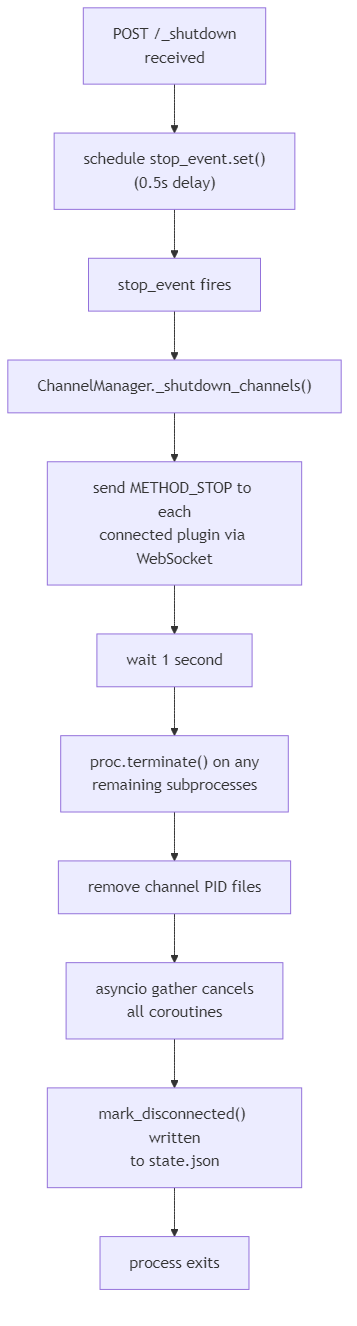
hirocli stop calls POST /_shutdown, then polls is_running(pid) for up to 10 seconds. If the process exits within that window, the stop is considered successful. If it does not (e.g. the server was not yet fully started and the HTTP port was unreachable), it falls back to kill_process() — force kill as a last resort, not the default.
Restart paths
There are two distinct callers that can trigger a restart, and they require different mechanisms.Path 1 — External caller (CLI)
hirocli restart runs as a separate process, outside the server. It calls _do_stop() to send POST /_shutdown and wait for exit, then calls _do_start() to spawn a new detached background process. This is the simplest path: sequential stop → start, with full control over the new process flags (admin, foreground).
Path 2 — In-process caller (admin UI)
The admin UI runs as a coroutine inside the server process itself (it is one of the tasks inasyncio.gather). When the admin UI calls RestartTool().execute() via POST /invoke, the tool detects that os.getpid() == server_pid — it is running inside the process it wants to restart. Calling _do_stop from here would kill its own process mid-execution before _do_start could run.
Instead, the tool calls request_restart(admin=admin) directly — a synchronous function in http_server.py that:
- Sets
_restart_requested = Trueand_restart_admin = <value>in module state - Schedules
stop_event.set()viacall_later(0.5, ...)on the running event loop - Returns immediately, allowing the HTTP response to be sent
_main coroutine then shuts down normally. After the shutdown sequence completes — after all coroutines cancel and mark_disconnected() writes state — _main checks is_restart_requested(). If true, it calls _spawn_server(), which launches a new detached server process and writes its PID, then the old process exits.
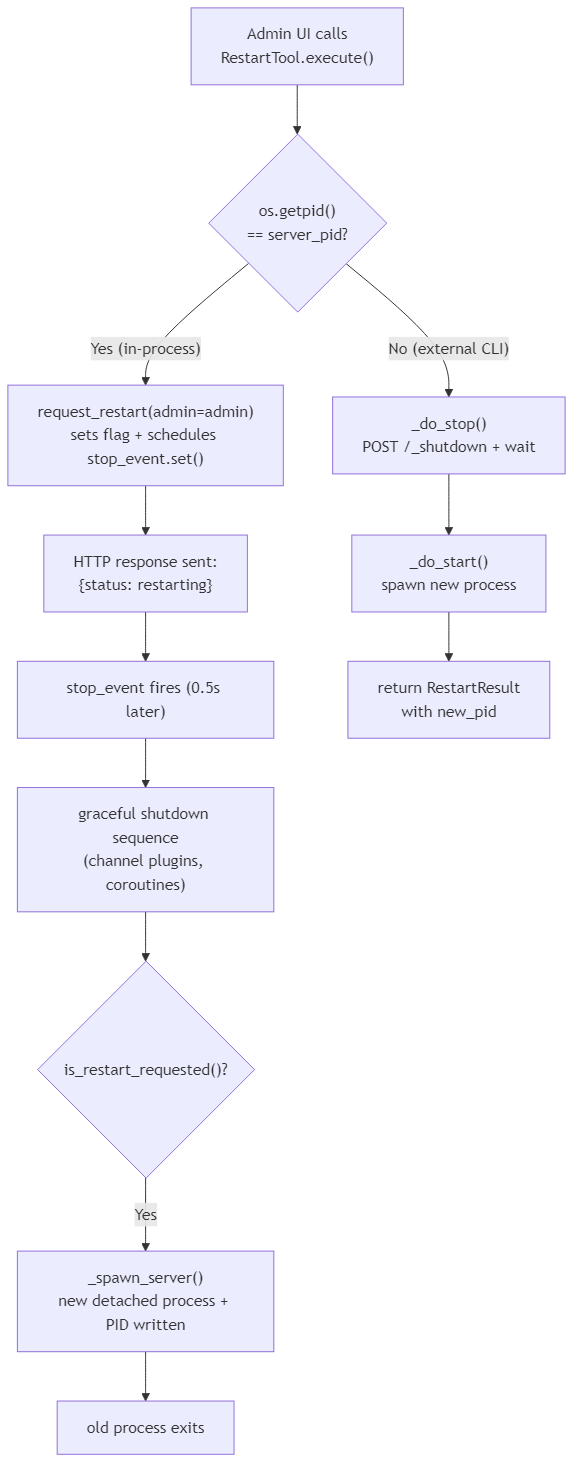
new_pid=None in RestartResult because the new process PID is not available until after the current process exits. The admin UI can poll GET /status on the HTTP port to detect when the new server is up.
Sequence summary
| Caller | Stop mechanism | Start mechanism | new_pid in result |
|---|---|---|---|
hirocli stop | POST /_shutdown → wait → force kill fallback | — | — |
hirocli restart | POST /_shutdown → wait → force kill fallback | _do_start() spawns new process | Available immediately |
Admin UI (/invoke restart) | request_restart() sets flag + schedules stop_event | _spawn_server() runs after shutdown | None (process not yet started) |
Module responsibilities
| Module | Responsibility |
|---|---|
runtime/http_server.py | Owns _stop_event, _restart_requested, _restart_admin. Exposes /_shutdown and /_restart endpoints. Exposes request_shutdown() and request_restart() for direct in-process use. |
runtime/server_process.py | Sets stop_event on http_server at startup. Checks is_restart_requested() after shutdown and calls _spawn_server() if set. Owns _spawn_server() which mirrors the background spawn logic from tools/server.py. |
tools/server.py | _do_stop() calls POST /_shutdown and waits. RestartTool detects in-process vs external caller and dispatches accordingly. |
hiro_commons/process.py | stop_process() / kill_process() — force kill fallback, used only when HTTP is unreachable. See process spawning for background process management conventions. |